
'And So It Felt Like This' - Women Sharing Our Ugly Truths
Rhonda reflects on two iconic women artists united by pain.

I’m on the third floor of the Tate Modern, crying my eyes out for the second time in a day.
The first time, I was in the museum’s new exhibition Frida: the Making of an Icon (until 3rd January 2027), where as a visitor you’re almost immediately faced with a short piece of vintage (but gorgeously colourful) home-movie footage of Kahlo with her husband Diego Rivera – bringing his hand to her cheek, kissing his face.
At one point the artist looks frankly, unabashedly, at the camera, and that’s when it hits me. Frida Kahlo is indeed such an icon (part of this exhibition shines a light on ‘Fridamania’ – the global commercialisation of her art and her aesthetic) that it’s hard to remember she was a real woman, made of flesh and blood like us. But something in the ages-old gaze of this woman who died 72 years ago, long before I was born, makes me feel seen. Frida, this sliver of home movie shows me, this gaze tells me, was an everyday woman, like me: messy, loving, broken in parts, feisty, fighty, placating, joyful, sorrowful… Human.
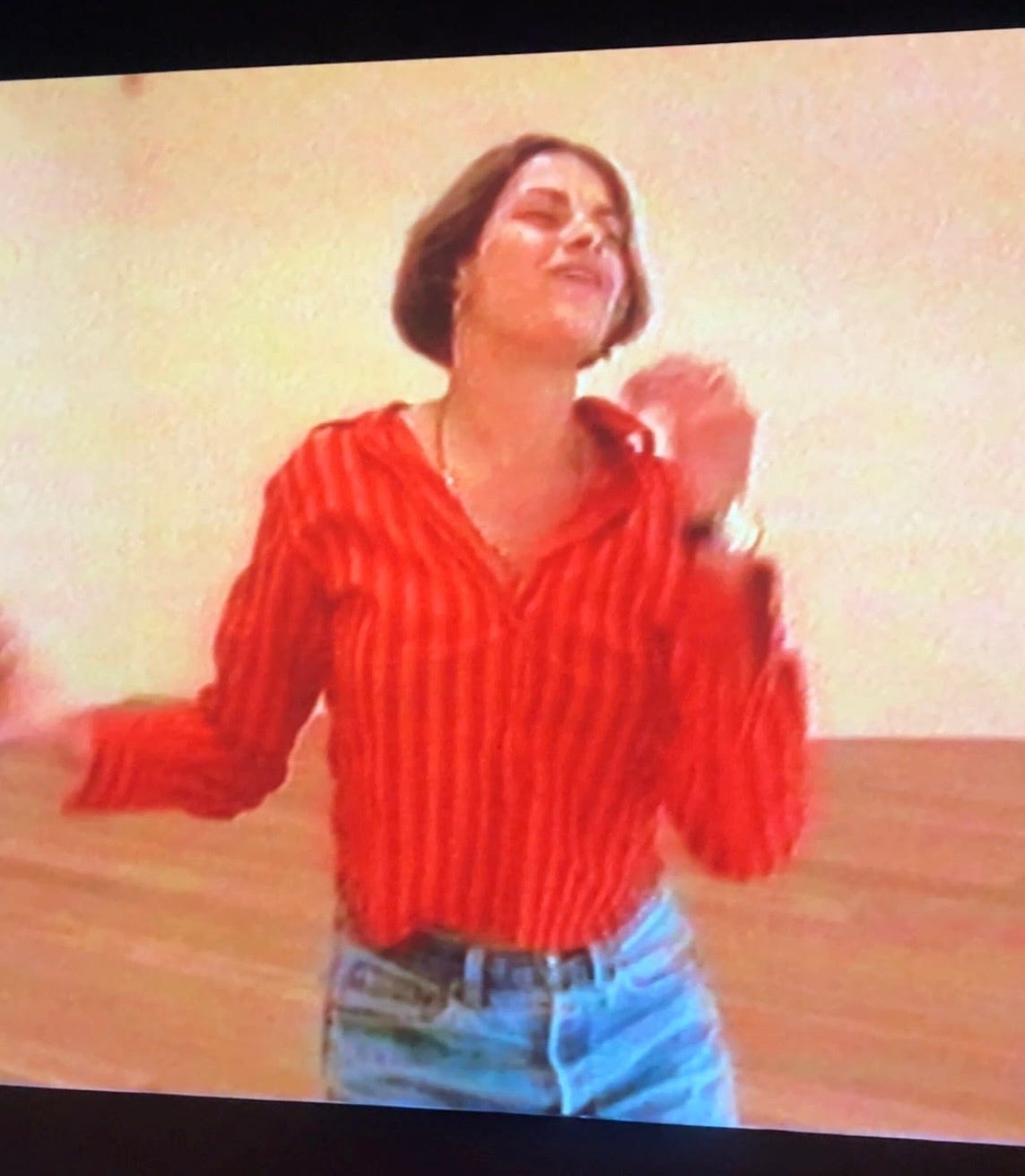
Now, a few hours later, I’m in the Tracey Emin: A Second Life exhibition (to 31st August), watching a six-minute projection and sound installation (originally shot on Super 8 film to give it a similarly intimate, home-movie feel) in which Emin recalls her impoverished childhood in seaside Margate, where underage sex and drinking gave some kind of relief in a place where the most likely option for a girl reaching the age of 17 was to have two kids and, if you were lucky, a council house.
Desperate to escape, teen Tracey, for whom dancing feels like freedom, enters the British Dancing Championship. Only before too long she’s stopped by the chanting of some of the men who she’s slept with, most of them much older than her, and hence actually criminals:
‘Slag, slag, slag.’
The footage segues into Tracey, older now, dancing solo in an empty space to Sylvester’s You Make Me Feel (Mighty Real). The abandon, the sheer joy on her face, the sheer delight in moving her body radiates out.
I’m crying again. Crying for all of us, for Tracey Emin, for myself (my own teenage fuck-ups and the later ones too), for the women I know and for those I don’t know. We have it so hard. We carry so much. Our bodies bring us unwanted attention, lead us astray, deliver us pleasure and pain, let us down, frighten us, attach us to people and then leave us feeling abandoned. It’s hard being a girl, a woman.
Much of Tracey’s work in the rest of the exhibition is about her abortions (one highly traumatic and almost resulting in death) and the aggressive bladder cancer that also nearly killed her. Her gaze is unflinching, and ours has to be too. It’s why we’re here. As in the Frida exhibition, the vast majority of visitors to A Second Life are women. We’ve come here to feel seen, to feel less alone. We see Tracy’s famous bed surrounded by tampons and fag packets and empty vodka bottles and dirty knickers and all manner of other detritus, we see the stoma created to reroute her urinary system, we see the mangled foetus slipping out of her in ‘And So It Felt Like This’, we see degradation, and we see the loss of innocence and illusions. And we see ourselves.
I came here struggling, having just gone through an unexpected, unwanted break-up. The fact that heartbreak befalls all of us at some point doesn’t make it any less painful. But it does make it more bearable. The two are not the same thing. Pain just has to be, somehow, borne. And art, by immersing us its specificity but also its universality, can help us to feel less like victims of some cosmic spite.
I’ve talked to a lot of women about where my head is currently at – sister souls, close friends, acquaintances, even complete strangers (oversharer, me?!?!). Women tend to discuss intimate things much more quickly than men – that’s how our co-memoir Wayward Women starts, with Tracey Davies and I bonding over life experiences with a group of random women at Mermaid Camp (yes, an actual school for mermaids!) at Weeki Wachee on Florida’s Gulf Coast.
And one thing that has struck me as I’ve been consoled and comforted in the arms both literal and metaphorical of other women has been how much we all carry. The everyday cares, the burden, often, of doing the vast majority of the emotional labour, the bashing of one’s head against the brick wall of weaponised incompetence, the noticing and remembering of things that otherwise wouldn’t be noticed or remembered, and would go undone, causing havoc. The huge sense of disappointment and the disillusion and even tragedy of never achieving our full potential because of all these things combined.
And that’s even before the trauma: the bleeding, the pregnancies wanted and unwanted, the cataclysm of childbirth, the giving over of one’s body to small humans, the loss of self, post-natal depression, the difficult, terrible choices one sometimes has to make and the resulting guilt and regret, the harassment, the societal injustices, the domestic abuse, the sexual assaults and so many other ordeals.
And then to have the strength and the will and the energy to turn all of these into art - to share the pain, to transmute it into consolation and often even beauty. It’s brave, and it’s necessary, and it’s everything. Somehow we still have the strength left in our arms to carry one another.
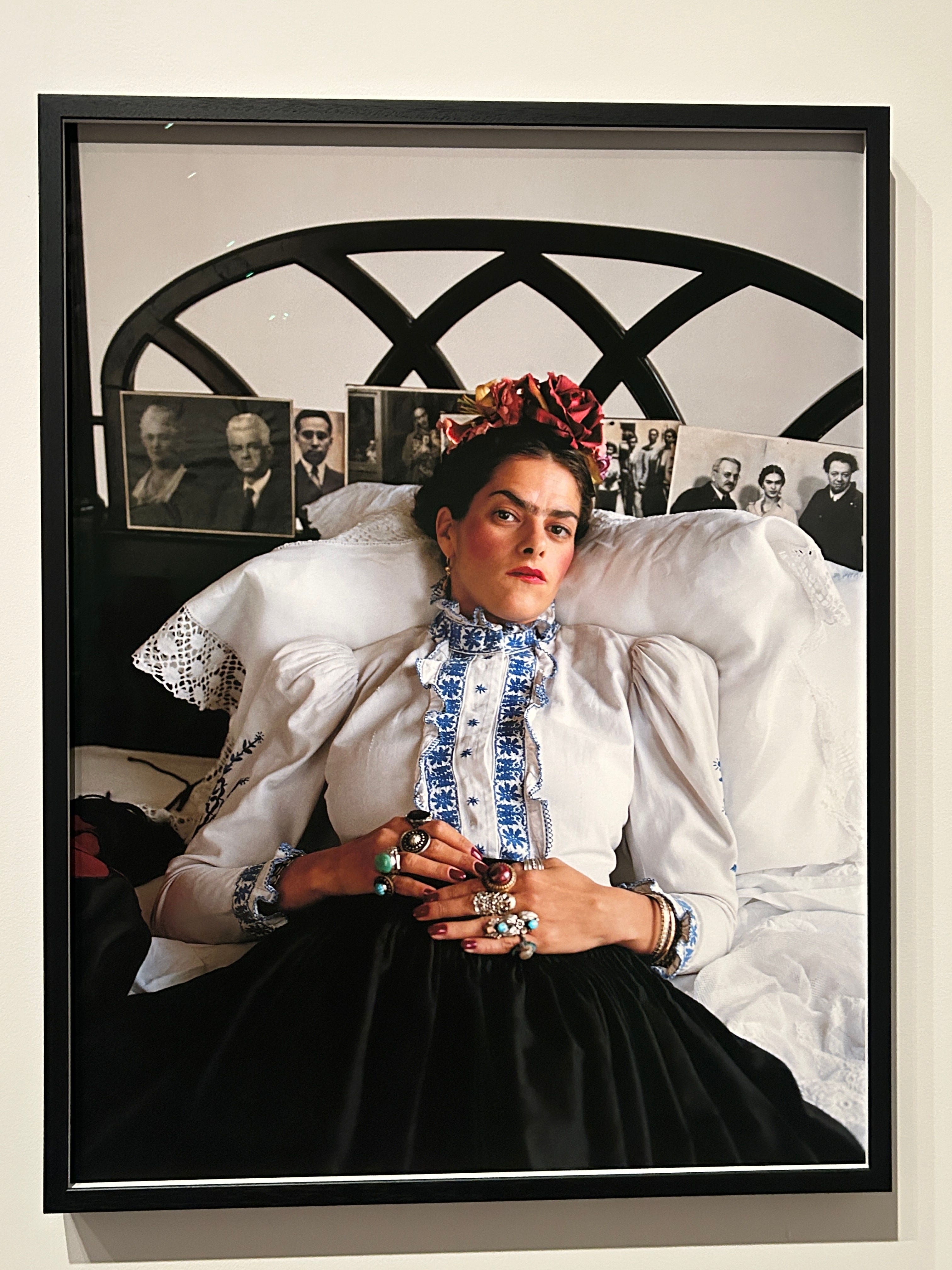
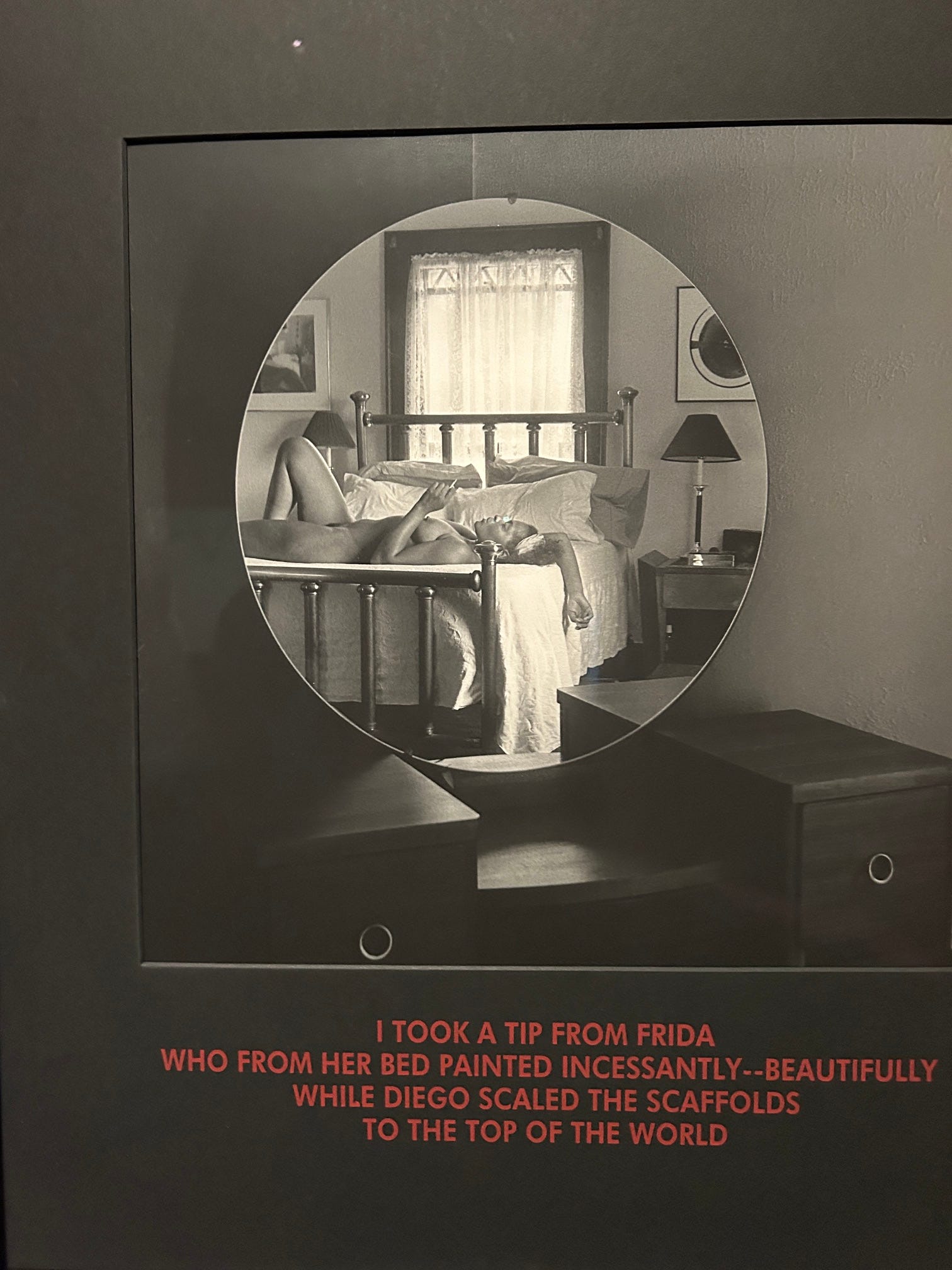
There’s too much to be said about these remarkable exhibitions in their own right and as experienced together, back to back, but seeing Tracey Emin dressed as Frida IN BED in the Kahlo exhibition nearly exploded my brain. Tracey’s aforementioned My Bed was a reconstruction of the place where she spent four days enduring a nervous collapse after a break-up, while Frida had to spend a lot of time in bed after her bout of childhood polio, her collision with a streetcar in her late teens, and the surgeries required to manage her lifelong injuries. Indeed, Frida often even painted in bed, using a customised easel. One photographic work in the Tate exhibition, by contemporary artist Carrie Mae Weems, references this in a caption: ‘I took a tip from Frida, who from her bed painted incessantly – beautifully, while Diego scaled the scaffold to the top of the world’ (Diego Rivera’s career took precedence over his wife’s, obvs).
Seeing these two shows at the same is brutal, punishing and highly recommended - hats off to the Tate Modern for this incredible programming. Even better, these two brilliant exhibitions will be joined, as of 15th July (through to 17th January 2027) by an exhibition dedicated to the Cuban artist Ana Mendieta, whose potent body of work and tragic life story will only add to the conversation about the power and importance of women’s art and of telling our truths, however ugly they may be at times.
Yes!!!